Chapter-6
Assistant Engineer (AEN), Gomoh
Another surprise was in store for me as after working as AEN (Line)/Asansol for a month, I was posted as AEN/Gomoh in place of Sri S.N.Jha. He had completed 3 years in this post, so it was a routine transfer for him but for me it was a cherished posting. The handing over/taking over process spread for about a week. Sri Jha took pains to show me the entire section ( On the Grand Chord- from Dhanbad to Hazaribagh road & and on the CIC section- from Gomoh to Chainpur ) in a motor trolley. On the day of handing over/taking over charge we remained in the office. At the appointed time the staff had gathered in the chamber. While Sri Jha sat on the official chair I sat opposite to him. The charge reports were prepared. The key of the chest containing cash imprest and reference books were handed over to me along with the bronze silver pass. After signing the charge report we both stood, shook hands amongst clapping by the staff and exchanged the chairs. I will never forget the nostalgia attached to this historic moment. The AEN bungalow was stately and near the bungalow which my father-in-law occupied while he was T.I. Gomoh in the fifties. In addition to the main gate there was a side gate opening towards the yard. A badminton court was provided on the lawn. Apart from a swing, the premises had umbracious mangoes and chikoo trees. There was a wooden staircase for accessing the roof and having a good view of the railway yard. Seasonal flowers embellished the driveway.
The trolleymen were Mitan, Harkhoo, Haria, Jagannath and Bandhu- all smartly dressed and vigilant all the time. They lived in the quarters in the premises of the bungalow and were available at call in case of train accidents. The quarters of the Assistant Electrical Engineer was next to the AEN bungalow.
Within a couple of days of my joining the local RPF Inspector came to me and informed me that as per the convention the main flag hoisting near the station is done by the AEN. He added that after the flag is hoisted and the National anthem is sung he would approach me and ask if the parade (a small contingent of RPF men) should be dispersed to which I should reply ‘yes’. Senior Inspectors from all the departments were posted at Gomoh. Naturally officers from the Divisional office at Dhanbad regularly visited this station. There was a modest Health Unit near the station, manned by an Assistant Medical Officer. The European Institute located on the south side had a wooden floored badminton court. The Indian Institute was situated next to the station and provided entertainment with film shows. A branch of the Eastern railway Mahila Samity also existed here. My wife was its president. Mahila Samities operate under the Staff Benefit Fund scheme in order to help women members of employees’ families in augmenting the family income by learning vocational skills like stitching uniform, weaving, and making some stationery items required by the Railway.
The steam loco shed- Even after electrification of the GC section it held a substantial number of steam locos operating in non-electrified Gomoh-Barkakana section and the colliery sidings taking off from it ,including the IEL siding at Gomia. During steam days, the locos of all mail and express trains were changed here for which a Turn-table was provided. After electrification of the Grand Chord section, changing of locos was not required but the place retained its glory as a crew changing station. The Gomoh based Anglo-Indian drivers whom I would be meeting during footplate inspections included J Greene, K.Greene, Walker, Watson, Stalky who mostly lived in the European colony on the south side of the yard. It also housed the Accident Relief Train (ART) and the Accident Relief Medical Equipment (ARME) with a loco in readiness round the clock. The blowing of the siren, installed in the loco shed signalled a train accident and prompted me to leave aside all the works and ring the staff manning the ‘Loco booking’ to ascertain the location & nature of the accident. Whether one’s presence is required at an accident site is generally decided by his controlling officer. In case of doubt it is better to be at the accident site than to face embarrassing queries afterwards. There were periodic alarms also to test the preparedness of the staff and their response to an emergency. On hearing the siren when we assembled near the ART. Simply our attendance was taken and we were dispersed.
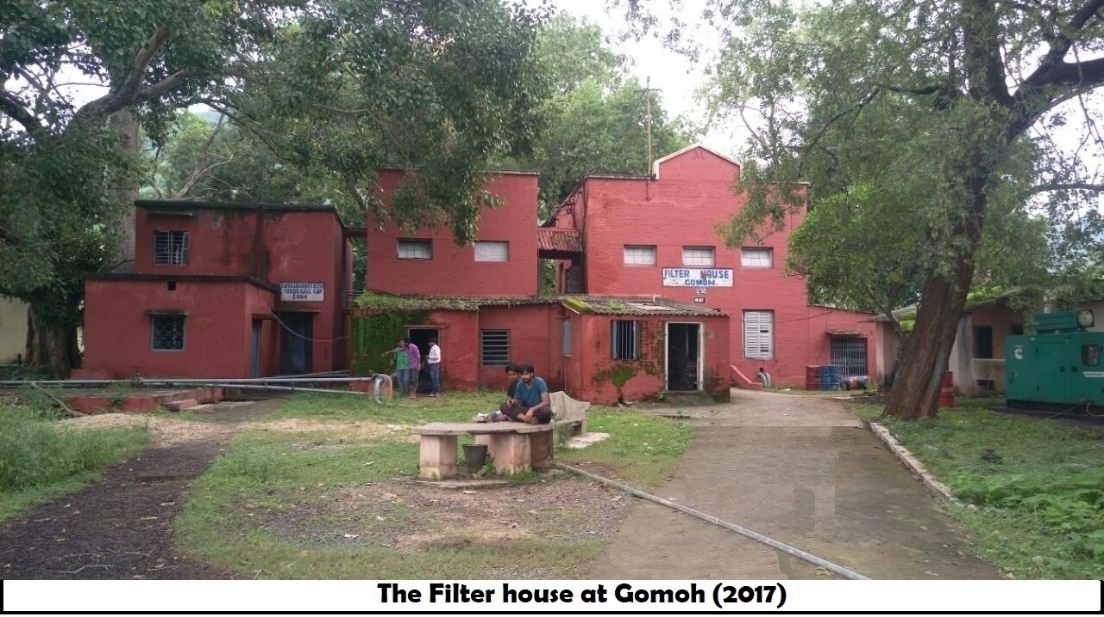
Water-supply- The sources of water were three ground reservoirs (Upper Chowrapatty , Lower Chowrapatty and Gomoh nalla) which stored water by means of dams. A well was also installed on the bed of nearby Jamunia river. In summer months the water levels in the reservoirs (Chowrapatty and Gomoh nala) depleted and we had to cut channels in the bed of the Jamunia river to augment the ingress of water into the well. Filtration was done by a Rapid-gravity-sand-filter. The filtered water was chlorinated by means of a ‘Chloronome board’. The main water treatment plant & the filtered water reservoir were located in a picturesque surrounding on the top of a small hill. The availability of power at Gomoh was very poor with the result that electric pumps would not work causing a water crisis at the loco shed. Finally, a DG set was installed.

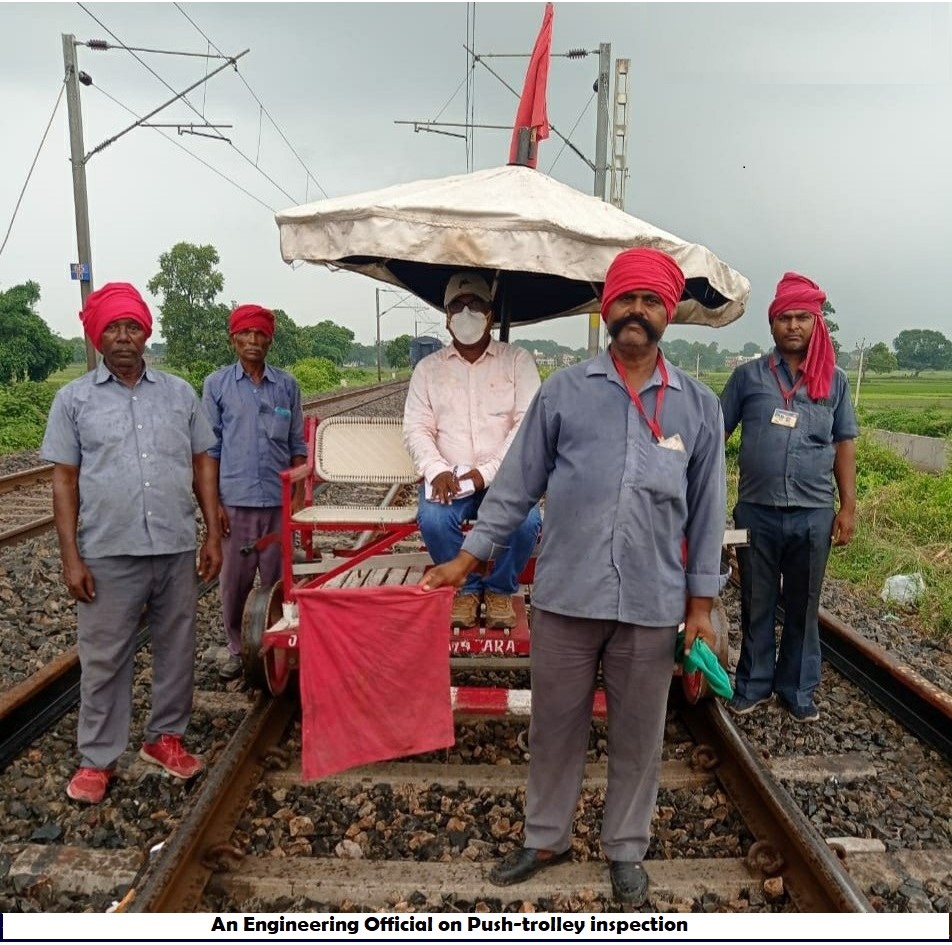
In the coming days The DEN Sri A.V.Venkatraman came for inspection. While trolleying he said, ‘The two tracks (UP line and the Down line ) are like your two eyes. Love them and take care of them. Accidents happen only when the PWI is sleeping, the AEN is sleeping and the DEN is sleeping. So not only remain vigilant but also see that your PWIs remain so’. Sri S.N.Sachdev was the Divisional Superintendent/ Dhanbad. There was an inspection quota for the AEN. The entire section was supposed to be covered by push trolley/motor trolley once in a month . While trolleying in the section the eyes remained riveted to the track; but while stopping at a station I spared time to go through the ‘Petty repair book’ also and interacted with the SM for any help. At the end of the month the trolley chart was submitted to the DEN who used to question shortfalls, if any. In addition, I had to conduct footplate inspections to detect spots where the running was rough. On entering the locomotive cab I first disclosed my identity to the driver & showed him the metal pass. During the run , apart from the location, type of lurch felt whether Lateral (L) or vertical (V) or both lateral & vertical (LV) was recorded. The caution-order (OPT-80) issued to the driver was also checked. Shuttle- copy books on progress of works and track renewal submitted every month to the DEN and in turn by him to the CE were useful contraption of management information system.
The Division brought out a booklet every year on monsoon-preparedness. I regularly received weather warning XXR(immediate attention) telegrams from the meteorological department about storm, gales and heavy rainfall. Wagons (bearing AEN GMO) loaded with monsoon reserve materials (coal ash, boulders) were kept ready in Gomoh yard. During heavy rains the gangs used to come out of their own to see that the rain- water does not accumulate in the yards. Mobile patrolmen were deputed for Chowdharibandh-Chichaki section and static patrolmen for the Damodar river bridge at Rajabera. Even myself and my PWIs chose to come out to be on the footplate for checking their alertness as also the track condition. Such was the apprehension of an accident or a bank slip or boulders falling on the track in a deep cutting or obstruction put on the track for sabotage, that even while proceeding on leave by Ranchi-Patna express I remained alert so long as the train was running in my section and went to sleep only after it crossed Hazaribagh road.

It was my first open line posting and I owe to my experienced Permanent Way inspectors and Inspector of Works to equip me with the nuances of Way and Works ,their maintenance and dealing with group D staff specially of the following categories:
Gangmen- They are the lowest level of the railway hierarchy. Normally their duty is attention to track under the guidance of the Mate. In the morning hours they assemble at the tool box, collect tools and walk to their day’s place of work, where they toil for their designated duty hours. Since their worksite is a running line they have to be self aware, attentive and alert. In case of emergency, they go beyond call of duty. During routine inspections I was required to check their tools & equipment, quality & quantity of their output, test their knowledge of rules and record my observation on the inspection book. In case they were found defying the instructions of the Mate, they were taken to task. I also made it a point to ascertain their grievances with regard to payment of their wages, grant of leave, advancement of loans, supply of uniform etc. In the later years of service, I noticed some perceptible changes in their lifestyle. Almost each one carried an aluminum tiffin carrier and there was a transistor for the gang (of about 20 persons).
Keyman- The fellow carrying a keying hammer, a spanner, a few spare fittings, flags and detonators faithfully walks on the track examining the fittings & fixtures, tightening the loose fittings and replacing missing ones.

The entire gang beat (about 5 kms) is covered by him by the end of the day. In case of unsafe conditions, he protects the track. If a particular stretch of track warrants urgent attention, he informs the mate.
Mate —He is head of the gang directing the entire sequence of track attention in day-to-day work. He is literate enough to read the number of telegraph posts, record the attendance and interpret the instructions of the Permanent Way inspector recorded on the gang chart. Once in a week he exchanges duty with the keyman so as to keep himself acquainted with the condition of track in his beat. If there is heavy rain, he comes out of the gang hut with his men to attend to the drainage of the yard and cutting.
Patrolman- Patrolman:- During monsoon the vulnerable sections are patrolled by smart and sincere gangmen. Equipped with a cape, cap and gumboot, they walk in a group of two carrying patrol book, hand signal lamp and detonators. They exchange patrol book with those on the adjacent beats. On arrival at the station, the patrol book is signed by the station Master. When they meet a train, they whistle and display their number plate to the driver. On sensing danger to the track, they protect it in accordance with the prescribed procedure. The Inspectors and officers of the engineering department conduct footplate inspection from the cab of the locomotive to check the alertness of the patrolmen. Thus if during a train journey you hear a fluting whistle in the eerie silence of a monsoon night, please remember the slogging patrolmen tasked with the safety of your train
Gate keepers- The level crossings outside the station limits are manned by the gatekeepers of the engineering department.
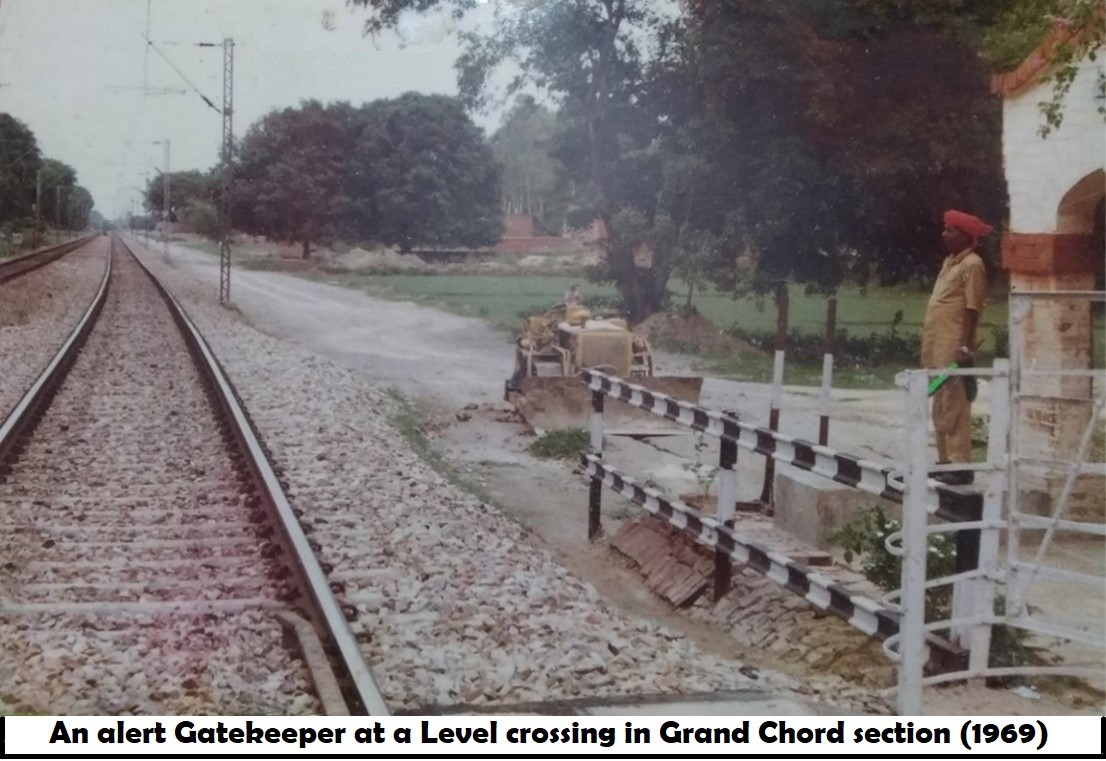
Clear instructions exist about the sequence of closing & opening of the gate leaves /barriers, maintenance of the flange way (gap between the running rail and the adjacent rail provided for holding the road surface) and action to be taken in case of obstruction on the level crossing. While a train is passing through the level crossing in the daytime, he stands alert with flags duly furled up on separate sticks -red flag in his right hand and the green flag in the left hand. During the night hours he holds the lighted hand signal lamp with white light facing the track. He is not supposed to exchange signal with the driver or guard of the train. But should he see a broken coupling or something unusual with the train he is required to shout and gesticulate. In case of obstruction on the level crossing (a stranded vehicle, the hoof of a cattle caught in the flange way) he should proceed to protect the track first and not to waste time on removal thereof as a train may arrive in the meantime causing disaster.
Trolley Ball Signal (TBS) man- In cutting on a curve the visibility is not sufficient for removing the trolley from the track in time at the sight of a train. For such a location a TBS man is posted on the top of the cutting with a trolley ball signal (circular disc with yellow and black stripes) mounted on a long mast with a handle at the base. The TBS man has good visibility of approaching trains as well as the trolley. When no train in sight he displays the disc to the trolley in static position. On seeing a train he waves the disc to and fro to warn the trolleyman who continuously keeps looking to the TBS man while entering the cutting.
Abbreviated forms of some of the common messages:
SAPONE-Track under repair. Look out for danger signal.
SANITY- Bridge under repair
SARDIS- Follow speed restriction
TAMPER-Proceeding on leave
Speed augmentation- Almost simultaneously with my joining as AEN/Gomoh, the railway had procured ‘Group’ electric locomotives manufactured by Hitachi-Mitsubishi-Toshiba group of Japanese companies. Of them the WAM1 type showed high oscillations at a particular speed. Extensive trials were conducted on them by running them over different sections followed by inspection and certification of the track by an engineering official. It was finally concluded that the frequency generated by the loco at about 70 kmph on 39m rail panels matched with its natural frequency of vibration causing Resonance and hence high oscillations. After generating debate at high level the loco was cleared by the Railway Board for main line operation.
Hitherto the maximum operating speed of the trains was 100 Kmph. As a prelude to introduction of high speed (over 100 kmph) trial runs, a train with special coaches and locos under supervision of the Research Design & Standard Organization (RDSO) arrived in my jurisdiction. The Chowdhariband- Chichaki section abounding in sharp curves and limiting grades were chosen for trial runs. We were scared but the RDSO officials who had taken extensive track readings and watched the track behavior under the then permissible speed, injected courage in the engineering officials. After every trial run, I had to inspect the track in a motor trolley. Normal train services would be resumed only after certification of track by me. When High speed Trial Express (HSTE) loaded with sandbags were introduced they had to be accompanied by the engineering officials on the footplate. Gomoh was the only stopping station between Howrah and Mughalsarai. Even when Rajdhani Express was introduced during my tenure as AEN/Gomoh in 1969, Gomoh retained its prestigious position which was subsequently changed to Dhanbad.
 For raising speed in a section the track needs upgradation by provision of heavier section of rail, concrete sleepers, increased ballast cushion, increasing superelevation on curves, elimination of diamond crossings, mechanized track maintenance & periodical recording of track parameters etc. At the same time the wagons/coaches, locomotives and standard of signaling & interlocking also need upgradation. The safe speed of the section is the minimum permissible safe speed of all the above. While according sanction for introduction of Rajdhani express, the Commissioner of Railway safety (CRS) had stipulated that the coaches will be all-coiled ICF type provided with D.A. valves & slack adjusters. The locomotive was to be WDM4 type with short hood leading. There were to be no unmanned level crossing on the route. For the first time hitherto maximum speed of 100 Kmph became restricted speed at location such as ‘Diamond crossing on run-through line’ as decided by the engineers.
Chowdharibandh-Chichaki—The section was full of curves & deep cuttings requiring vigilance on proper functioning of the side drains and catch water drains. A pair of curves of contrary flexure existed with no scope of admitting in-between them a straight at least equal to one-coach-length. They were accordingly realigned as a Reverse curve with a ‘Point of contraflexure’. I found rough running on Down cross-over trailing point at Chichaki . Due to proximity of a level crossing the misalignment could not be set right. Its shifting required concurrence of the state govt & CRS’ sanction. Finally I was advised that the level crossing lay on a village road and small shifting of the same in a remote area would go unnoticed. Acting on it ,the level crossing was shifted for a small distance and the point realigned. The running thereon improved.
Accidents & incidents-Accidents have potential of inflicting injury/loss of lives and/or damage to the railway property. Incidents cause delay to the trains. While on this post I had to attend the first train disaster involving loss of human lives. One coach of 17 Up (Sealdah-Pathankot Express), after leaving Parasnath, caught fire. It passed Choudhariband unnoticed. The passengers of the affected coach finding the condition unbearable jumped off getting killed/injured in the process. The train was stopped at the next station Chichaki. The primary responsibility lay with unknown passenger carrying inflammable material. The secondary responsibility fell on the driver and the guard who failed to observe rules which required them to look back/forward at the train on curves to see its condition. There were both left hand and right-hand curves which the train traversed after leaving Parasnath. Had the driver & the guard been vigilant, they would have noticed the fire flame. But they failed in their duty.
There were two unfortunate occurrences resulting in fatalities. (a) At Matari station one gangman was dating (putting year of laying) the newly laid wooden sleepers on the Down GC by means of chisel. A flagmen was suitably posted to warn the gangman of an approaching train. On seeing 18 DN (Pathankot-Sealdah express) approaching the station the flagman shouted and waved red flag but simultaneously a goods train arrived on the UP line and shouts of the flagman was drowned in the rattling of the goods train. The poor gangman could not move away in time from the speeding wheels 18 DN which was not scheduled to stop at Matari. (b) A pair of gangmen were patrolling the down GC between Nimiaghat and Parasnath stations. As per rule they were walking on the track in the direction opposite to that of movement of trains so that they could see an approaching train. Unfortunately, due to some operational constraint there was a single line working on the down GC and an UP train was diverted on the Down line. This was something unforeseen for the patrolmen who realized too late an approaching train from behind.
Bad riding-One night I was awakened from sleep as the driver of a down goods train on arrival at Dhanbad had reported ‘bad riding’ between Tetulmari & Dhanbad. As per rule, further train movement was stopped till the track was certified fit by an engineering official. I with my PWI and some gangmen boarded 2 Down (Kalka mail) which was waiting at Gomoh station. The train was allowed to run at designated speed upto Tetulmari and then slowly. It was stopped short of the reported location. On detailed examination of the site nothing unusual could be found out. After some routine attention to the track, we boarded the train and piloted it up to Dhanbad. The track was certified fit at a restricted speed of 30 Kmph which was relaxed the next day after thorough attention in broad daylight.
Railway affecting tanks--While going through the register of the Railway affecting tanks I was bemused to find that the list also included picturesque Topchanchi lake. It is an artificial lake formed by tapping the discharge of the streams flowing down the nearby Parasnath hill by means of a dam. The water so impounded is used for supply to the coal township of Dhanbad and Jharia ,some 30 kms away. The serenity attached to this lake had caught the fancy of the film star Uttam Kumar who dreamt of setting up a film city here. However, the destiny ordained it otherwise. It appears some kind CE included it in the list to permit the AEN annual picnicking at railway service. It was intriguing how distress to its dam or appurtenances could endanger the safety of the GC situated some 10 kms away.
Court summon- One day I received a summon from a Chaibasa Court ( judge- Sri Hari Charan Mittal) to depose in a case. From the sketchy description, I could make out that it was related to the arrest of striking casual staff during my posting at Dangoaposi a year ago. In the court premises first I met the PP who said that my evidence would be material and advised me to be firm on identifying the accused. I felt uneasy as this would have spelt doom for my ex-staff. First the Inspector of work appeared. Pointing out to the accused standing in another box, the defence counsel asked him if they were the same persons who obstructed the entry of the officers into the office. The IOW hesitated for a while and then said that he was not sure as the matter was over one year old. Thereupon the PP was beside himself and declared IOW as ‘hostile’. Then came my turn. The judge did not require me to come to the witness box and allowed me to answer from where I stood. The defence counsel-"How was the crowd behaviour? I mean were they peaceful or violent? Me- ‘They were peaceful’. The defence counsel- ‘Did they raise any slogan which was unbecoming of them?’. Me- ‘No’ . The counsel turning to the judge-‘ Your honour this may kindly be noted’. The counsel asked me – ‘What was the sequel of the strike?’ Me –‘I cannot say with certainty but I subsequently learnt that the strike was called off and the casual staff absorbed in the Rly.’ The counsel was highly pleased with my reply. He again requested the court to take a special note of what I had said just now. The counsel cleverly avoided the question he had put to the IOW . The cross examination was over. The PP was outwitted by the defence counsel. He was too puzzled to ask me any question. The court allowed me to leave. After sometime I got a letter from one of the accused thanking me for my deposition in the court which the defence counsel leveraged to seek staff acquittal . I was happy that without sacrificing the truth I had saved my staff from what was a clear case for their conviction.
 Farewell- There is a custom in the Railway to show marks of respect to the officer proceeding on transfer by placing detonators on the rails, ahead of the wheels of the coach occupied by him. As the train moves the detonators burst amidst clapping of those assembled at the platform to bid goodbye. I felt honoured to get this treatment while taking leave of Gomoh.
I will always commemorate the engaging days of this posting.